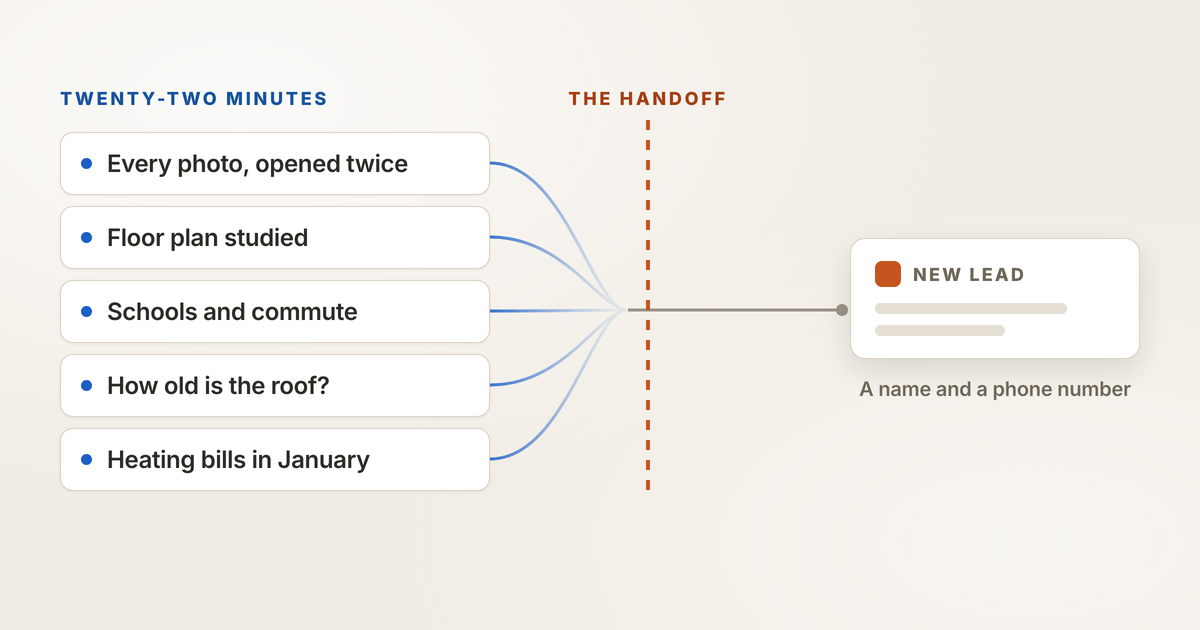
A visitor spends twenty-two minutes on one of your listings. They open every photo twice. They study the floor plan. They check the schools, then check the commute from the address to a downtown office. They ask how old the roof is. They ask what the heating bills run in January. They compare it against another home on a nearby street and come back to this one.
Then they ask for a tour.
Here is what reaches you:
Illustrative scenario representing the workflow pattern discussed in this article.
Twenty-two minutes of behavior and questions, reduced to a name and a phone number. The buyer now has to restart the conversation, the agent begins without context, and the seller — who paid to generate that attention — keeps almost nothing of what it revealed. Nothing malfunctioned. The page loaded, the form submitted, the email sent. The system did what it was built to do; it just wasn't built to carry anything forward.
This is the problem AI exposes but does not automatically solve. A sale is a chain of handoffs, and intelligence leaks at each one. Adding a smart tool to an isolated task may improve that task while leaving the underlying loss untouched. The pattern runs through investment, development, financing and property operations, but the residential sale makes it most visible, because information passes so rapidly between sellers, agents, buyers, platforms and transaction teams.
Adoption is not value
AI adoption is already widespread. JLL found that 92% of corporate occupiers were running AI pilots, but only 5% had achieved all their program goals; 47% had achieved two or three. Starting a pilot is easier than integrating it into a workflow.
Residential brokerage shows the same gap. In NAR's 2025 Technology Survey, 20% of REALTORS® reported using AI daily, while 46% said AI had made no noticeable difference to their business. Meanwhile the customer journey is already hybrid: NAR's 2024 Profile of Home Buyers and Sellers reports that 51% of buyers discovered the home they ultimately purchased through online search, while 88% completed the purchase through an agent or broker. Digital discovery and human guidance are not competing channels; they are consecutive stages of the same journey.
The opportunity is not to route around the professional. It is to reach them with the relevant context intact.
Four places where context disappears
Forget the technology for a minute and look at where information actually dies.
1 Property knowledge does not reach the buyer — or benefit the seller
An agent walks a property and notices the afternoon light, the connection between the kitchen and the garden, the quality of a renovation and why an apparent comparable is not truly comparable. The listing then reduces that knowledge to "three bedrooms, two bathrooms and granite countertops."
What differentiates the property — and the agent's expertise — never reaches the buyer. The seller loses differentiation, the buyer receives a thinner understanding, and the agent's knowledge remains largely invisible.
2 Visitor context collapses into a name and an address
This is Jane Smith, above — the point in the chain where the most information exists and the least of it survives.
The fix is not a chat bubble on a listing page. A generic bot that invents an answer about a roof is worse than no bot. What has to be true instead:
- It answers from approved property facts, your own local knowledge, and sourced third-party data — not from a language model's general impressions of the neighborhood.
- It shows where each answer came from, so you and the buyer can both check it.
- It says when it doesn't know, and routes anything consequential — condition, disclosure, negotiation, anything a licensee should own — to you.
- It hands you the conversation, not a notification.
Nothing is automated away; the agent simply enters the conversation better informed.
3 Transaction context fragments across documents and systems
Two offers differ on financing, contingencies, deposit, inspection, closing and rent-back — but the comparison lives across PDFs, messages and memory. Once an offer is accepted, its deadlines move into another system, and the reasoning behind the decision disappears.
The opportunity is not automated negotiation. It is a reliable connection between terms, decisions, responsibilities and deadlines.
4 What one sale teaches never reaches the next
A home sits for five weeks and sells after a price reduction. During that time, visitors revealed their concerns through their questions, comparisons and behavior. But when the next listing begins, the agent starts again with instinct.
At team or brokerage scale, questions, objections, campaign performance and outcomes should become institutional knowledge — not disappear with the transaction.
Which handoffs are worth fixing?
Not every information loss justifies new software. Fix a handoff when one or more of these is true:
- The information is perishable and cannot be reconstructed later.
- The handoff affects a consequential decision or customer action.
- The same information is repeatedly lost or re-created.
- Preserving the context could improve conversion, reduce risk, lower cost or improve the customer experience.
Having enough time to work manually is not the only test. An agent can answer every inquiry and still lose the questions of visitors who never make contact.
Measure outcomes, not activity
Usage is not value. Questions answered and messages generated describe usage; qualified tours, fewer missed obligations and better decisions describe value.
Count net benefit. If a tool removes ten hours but adds six hours of checking and correction, the saving is four.
| Stakeholder | What should improve | Possible measure |
|---|---|---|
| Buyer | Continuity and confidence | Repeated questions, unresolved issues, progression to tour |
| Seller | Return on listing attention | Engaged visitors, qualified inquiries, tours and offers |
| Agent | Quality of follow-up | Context received, response relevance, net time |
| Transaction team | Reliability of execution | Missed deadlines, unresolved dependencies, exceptions |
| Brokerage | Learning across listings | Repeated objections, pricing variance, campaign improvement |
| All parties | Risk and trust | Unsupported answers, escalations, complaints and review burden |
Establish the baseline before deployment — cycle time, labor, errors, conversion and information lost at each handoff. Then define the result that would justify keeping the system.
Bad data creates more work
JLL reports that more than half of corporate leaders surveyed identified data quality as a major barrier to widespread AI adoption in commercial real-estate functions. A system that speaks confidently from bad inputs does not save time — it manufactures a new category of work.
Real estate makes this sharper than most industries: a mislabeled maintenance request is an annoyance; an unsupported statement about a property's condition, a hazard or a boundary is a consequential error for which the agent may remain accountable. Review should scale with consequence. The workflow must show what is fact, what is inference, where the information came from and what requires human approval. Trust comes from making the system's limits visible, not from making it sound more confident.
Buyer intelligence creates a fair-housing design challenge. HUD clarified in April 2026 that discussing neighborhood crime and school information is not, by itself, a Fair Housing Act violation. A responsible system should nevertheless rely on sourced data, apply the same standards consistently, avoid characterizing who lives in a neighborhood and never recommend where someone would "fit." Automation does not remove the agent's responsibilities.
Ask a provider what its system does when someone asks whether an area is "family-friendly." The answer reveals whether it was designed around responsibility or conversion alone.
Start with the most consequential leak
Start with the handoff where lost information is perishable, consequential and measurable. For many residential teams, that may be the transition from online research to the agent's first conversation. For others, it may be transaction coordination or learning across listings. An agent with little digital traffic may need no additional system at all.
The organizations that benefit most from AI will not be those using the most tools. They will be those that preserve the right information at the moments when it changes a decision.
Practitioner note: EuKreate
This perspective is informed by building EuKreate, which examines one specific handoff: preserving relevant context from a visitor's property research when an inquiry reaches the agent. It is one application of the larger principle — find where information disappears, preserve what the next decision needs, and measure whether the outcome improves.
Sources: JLL, "Real estate's AI reality check," October 2025; National Association of REALTORS®, 2025 REALTORS® Technology Survey; JLL, "Future forward: The evolution of AI and its impact on commercial real estate"; National Association of REALTORS®, 2024 Profile of Home Buyers and Sellers. Fair-housing context: NAR, FAQs on Steering, Crime and Schools; HUD, Dear Colleague letter on neighborhood crime data and school quality, April 2026 (NAR summary).
Reactions
No reaction from you