The same conference room is too warm for the third time in eight weeks.
The first technician cleared an alarm and reset the controls. The second replaced a temperature sensor. When the third ticket arrives, the dispatcher can see the current complaint, but not the earlier automation alert, repair notes, sensor invoice or equipment warranty. They sit in four different systems.
Each ticket was closed. The property learned nothing from any of them.
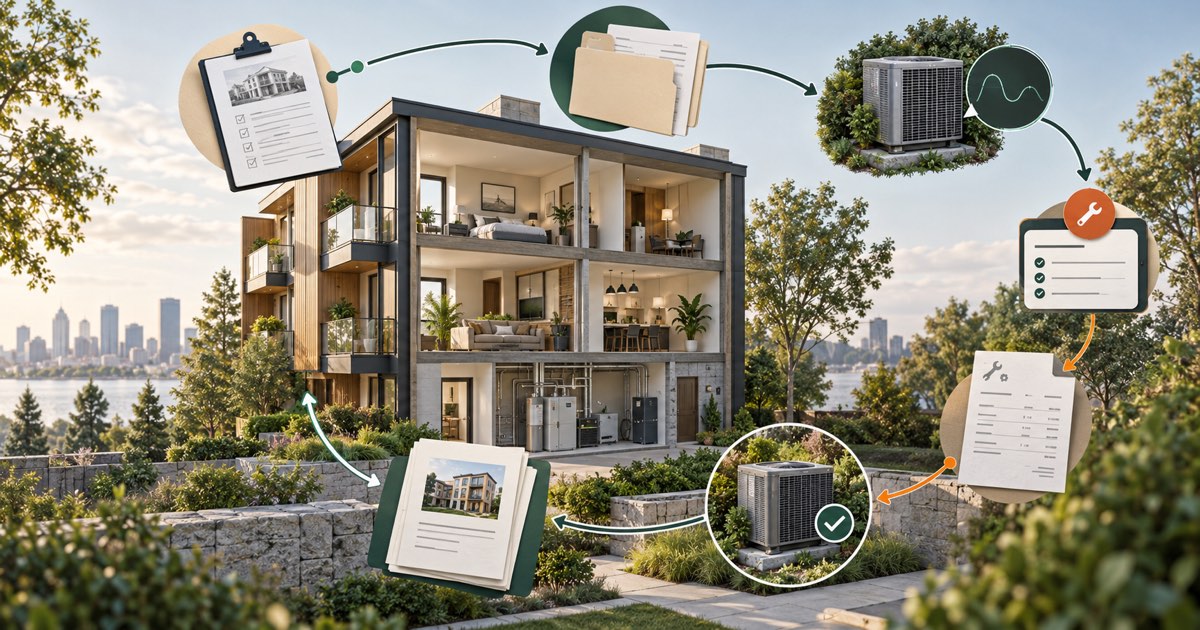
The larger opportunity for AI in property operations is to connect each signal, diagnosis, intervention and result to a living property record, so the next decision begins with what the property has already taught its operators.
The property and maintenance events in this opening are illustrative.
Closing should not erase the property’s memory
A transaction produces an unusually concentrated body of knowledge about a property: inspection findings, disclosures, warranties, equipment details, repair receipts, permits, photographs, floor plans, utility information and the explanations exchanged among buyers, sellers, agents, inspectors and contractors.
At closing, that knowledge often fragments. A warranty remains in an email attachment. The inspection report becomes a PDF in a drive. Model and serial numbers are entered into one maintenance system, while invoices live in another. A property manager inherits the building but not necessarily the reasoning behind its previous decisions.
Closing is therefore a workflow boundary, not the end of property intelligence.
A living property record would carry trustworthy information from the transaction into operations and continue to update it over time. It would connect:
- The property, spaces and equipment involved
- Source documents and the facts extracted from them
- Sensor readings, alarms and resident or tenant requests
- Inspections, diagnoses, work orders and invoices
- Warranties, service agreements and responsible vendors
- The outcome, cost and recurrence of each intervention
This does not require one enormous database or unrestricted access to every document. It requires a governed layer that identifies which asset a fact concerns, where it came from, when it was current and who may use it. Operational memory still needs purpose, provenance, access controls and retention rules.
More alerts do not create operational intelligence
Building systems already generate substantial data. The difficult part is turning it into an intervention that someone can understand, prioritize and verify.
These figures come from the U.S. Department of Energy’s 2016 to 2020 Smart Energy Analytics Campaign. They are campaign outcomes rather than a universal current benchmark, but they establish that building analytics can produce measurable value at portfolio scale.
The same research also identified the operational burden. Fault alerts could number in the hundreds or thousands, fault-detection tools required a median of nine staff hours per building each month, and lack of staff time to review and implement findings was among the most significant barriers participants reported. The organizations that acted on more findings had both analytical support and a routine process for following up with operations teams.
A detected fault is not a repaired fault.
A 2025 Pacific Northwest National Laboratory project illustrates the opposite problem. Researchers could not assess operational savings or maintenance avoided because the interventions they identified were not implemented during the demonstration. The maintenance tickets available to the project also lacked enough detail about fault causes and durations to build fault-free baselines or validate the fault-detection model. The operational record was too incomplete to distinguish normal from faulty behavior with confidence.
Taken together, the studies show the missing link. Signals must connect to the same asset and history, then return after intervention as verified outcomes. Otherwise, each system may be correct while the operating team remains uninformed.
A living record turns maintenance into a learning loop
The operational workflow should behave as a loop rather than a queue of unrelated tickets.
Asset identity, location, specifications, warranty, documents and prior work.
Decision supported: what is this, and what is already known?
Alarm, sensor change, inspection finding or resident report.
Decision supported: what changed, and how urgent might it be?
Related history, likely causes, confidence and consequence.
Decision supported: what should be checked first?
Human approval, dispatch, instruction, parts and timing.
Decision supported: who will act, and under what authority?
Finding, repair, cost, downtime and verification.
Decision supported: did the intervention solve the problem?
Confirmed condition, changed component and recurrence rule.
Decision supported: what should the next decision know?
↺ The updated record becomes the context for the next signal
Return to the warm conference room.
The complaint is one signal. The building-automation system also shows longer-than-expected runtime while the room temperature continues to drift. A dependable system can connect the room to the unit, retrieve the earlier work orders, show that replacing the sensor did not end the pattern and identify the active warranty.
It can then prepare the next decision: rank plausible causes, show the evidence for each, check whether the condition matches an approved response and route the issue to the appropriate technician. It should not present a probable cause as a confirmed diagnosis.
The technician inspects the equipment and finds an intermittently failing actuator. After replacement, the system compares subsequent runtime and temperature stability with the pre-repair pattern. The work order records the confirmed cause, part, warranty claim, labor time and verification result.
If the pattern returns, the team starts with a known asset, a history of unsuccessful and successful interventions, and a clearer escalation path. The property learns because a hypothesis was tested, a human confirmed what happened and the outcome returned to the record. It does not learn merely because more data accumulated.
Automation should stop where consequences outrun confidence
Many parts of this workflow can be assisted safely. AI can extract equipment details from manuals and invoices, match a request to an asset, summarize relevant work history, identify a deviation from normal performance, rank tickets against defined criteria and draft a resident update from an approved status.
The boundary changes when software can affect the physical environment.
Candidate for bounded automation
- Creating a work order when a verified rule is met
- Adjusting a noncritical setpoint within an authorized range
- Any response that is reversible, bounded and explicitly approved in advance
Requires human confirmation
- The diagnosis is uncertain, or competing signals disagree
- The action could affect life safety, security, essential equipment or building access
- A remote change could damage equipment or worsen occupant conditions
- The decision carries a material financial, contractual or resident consequence
- The system is being asked to operate outside a tested rule or approved range
NIST classifies building automation as operational technology: “programmable systems and devices that interact with the physical environment (or manage devices that interact with the physical environment),” a category whose listed examples place building automation systems alongside industrial control systems and physical access control. Its guidance is explicit that securing these systems means addressing “their unique performance, reliability, and safety requirements,” not information security alone. That is a different risk profile from summarizing a document or drafting an email.
The important distinction is not “manual” versus “automated.” It is whether the person accountable for the outcome can see the evidence, understand the limits and intervene before a consequential action is taken.
EuKreate currently works earlier in the property lifecycle, grounding residential-listing experiences in approved property information and carrying buyer context into the agent handoff. We do not operate buildings. The connection is the next handoff: inspection findings, equipment details and warranties assembled during a transaction are precisely the records an operator may later need. Once software can affect the physical environment, provenance, stated uncertainty and a visible human decision point become even less optional.
Measure whether the property is learning
Counting generated alerts, summarized tickets or automated messages measures system activity. It does not show whether operations improved. The stronger measures follow the problem through the complete loop:
- Time from signal to acknowledgment, diagnosis and resolution
- Repeat incidents involving the same asset or root cause
- Verified downtime avoided and service restored
- Energy or water intensity, normalized where possible for weather and occupancy
- Resident or tenant satisfaction after resolution
- False positives and recommendations rejected by operators
- Net staff time saved after review, correction and exception handling
These measures should be tied to a baseline. If a building used less energy after a control change, the team should still ask whether weather, occupancy or operating hours also changed. If repeat tickets fell, it should confirm that the issue was resolved rather than recategorized. If a prediction prevented downtime, the avoided event should be documented as an estimate, not presented as an observed fact.
This discipline prevents operational AI from becoming a dashboard of disconnected numbers. Three failures in particular should be visible rather than absorbed:
- A recommendation operators repeatedly reject should not return unchanged
- A repair that fails within two weeks should not remain recorded simply as completed
- A recurring fault should become more visible, not disappear behind closed tickets
The next ticket should begin where the last one ended
The warm conference room did not need a more eloquent maintenance summary. It needed continuity.
The initial complaint, control-system behavior, earlier repairs, warranty status, technician diagnosis and post-repair performance all described the same operational story. Fragmented across systems, they produced three separate tickets. Connected through a living property record, they could support one improving chain of decisions.
That is the opportunity after the transaction. AI can help organize evidence, find patterns, prepare decisions and monitor results. Operators still determine when the evidence is sufficient, when an intervention is safe and whether the outcome is acceptable.
A property should not lose its memory at closing.
Each intervention should make the next one better informed, and the next ticket should begin where the last one ended.
Sources
- Lawrence Berkeley National Laboratory, Proving the Business Case for Building Analytics, 2020. Reports results from the U.S. Department of Energy Smart Energy Analytics Campaign: 104 organizations, 6,500 buildings, over half a billion square feet, with median annual energy savings of 3% for energy information systems and 9% for fault detection and diagnostics, and a two-year simple payback.
- Lawrence Berkeley National Laboratory, Synthesis of Year Three Outcomes in the Smart Energy Analytics Campaign, September 2019. Source for the findings on alert volume, in-house labor, follow-up processes and barriers to implementation.
- Pacific Northwest National Laboratory, Final Report: Optimizing Facility Operations by Applying Machine Learning to the Army Reserve Enterprise Building Control System, PNNL-33364, January 2025. Prepared for the Environmental Security Technology Certification Program, project EW19-5300.
- National Institute of Standards and Technology, Guide to Operational Technology (OT) Security, SP 800-82 Rev. 3, September 2023.
Reactions
No reaction from you


